
Bonneville Flutes
Overview
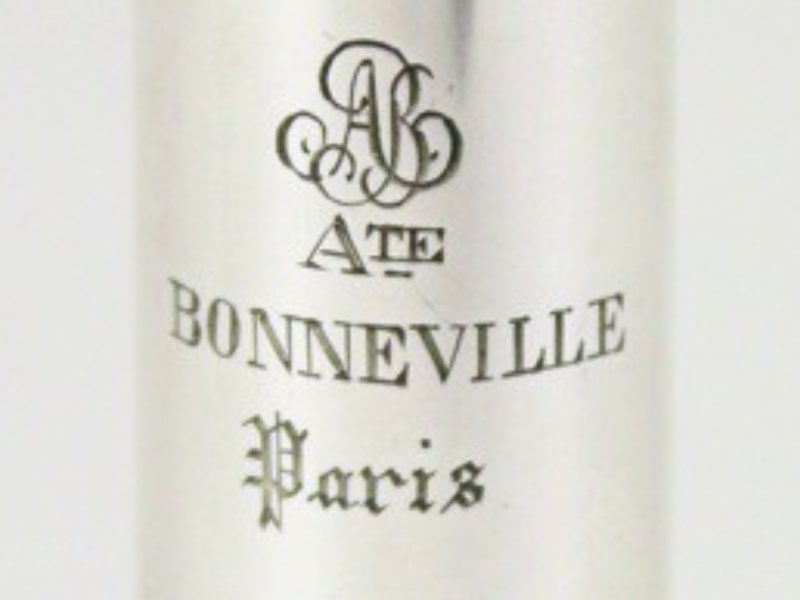
Founded in Paris by Auguste Adrien Bonneville (1819–1899), Bonneville was one of the leading French flute-making workshops of the late nineteenth and early twentieth centuries.
Renowned for exceptional craftsmanship, precision engineering, and refined acoustical design, the workshop became part of the distinguished French tradition established by makers such as Clair Godfroy Aîné and Louis Lot.
Trained as a silversmith, Bonneville is believed to have worked with — or supplied components to — the workshops of Godfroy and Lot before establishing his own business in 1858.
He began producing flutes under his own name during the 1870s, combining traditional French craftsmanship with meticulous mechanical construction and elegant artistic finishing.
Historical Development
The Bonneville workshop remained active across three generations of the Bonneville family and produced approximately 2,000 instruments, including flutes, piccolos, fifes, clarinets, and other woodwinds.
Throughout its history, the firm earned an international reputation for quality and innovation while continuing the French Böhm tradition established during the mid-nineteenth century.
Its excellence was recognized with major international awards, including a Silver Medal at the 1889 Paris Universal Exposition and a Gold Medal at the 1900 Paris Universal Exposition, confirming Bonneville’s place among France’s finest instrument makers.
Instruments and Design
Bonneville flutes are admired for their elegant proportions, responsive mechanisms, and carefully finished construction.
Many surviving examples feature the traditional seamed-tube body characteristic of nineteenth-century French flute making, reflecting construction methods inherited from earlier Parisian workshops.
The workshop produced instruments in:
- Silver-plated maillechort (nickel silver)
- Solid silver
- Gold-plated finishes
- Wooden models on selected instruments
In addition to concert flutes, Bonneville also manufactured piccolos, fifes, and other woodwind instruments for both professional musicians and advanced amateurs.
Sound and Performance
Bonneville flutes are known for their vibrant, flexible tone, quick response, and excellent projection. Many instruments feature relatively large embouchure holes, producing a broad, colorful sound while preserving the elegance associated with the French flute school.
Collectors and performers often describe Bonneville instruments as combining:
- Brilliant yet warm tone
- Excellent projection
- Responsive articulation
- Smooth key action
- Rich tonal complexity
Notable Achievements
- One of the leading Paris flute workshops of the late nineteenth century
- Continued the French flute-making tradition established by Godfroy and Louis Lot
- Produced approximately 2,000 woodwind instruments
- Awarded a Silver Medal at the 1889 Paris Universal Exposition
- Awarded a Gold Medal at the 1900 Paris Universal Exposition
- Renowned for seamed-tube construction and exceptional craftsmanship
Historical Significance
Although Louis Lot ultimately became the best-known French flute maker of the nineteenth century, Bonneville represents the second generation of the French Böhm tradition.
His workshop carried forward the work begun by Clair Godfroy Aîné and perfected by Louis Lot, preserving and refining the French Böhm flute at a time when professional flute design was becoming increasingly standardized.
Within the history of French flute making, a clear lineage emerges:
- Clair Godfroy Aîné introduced Böhm’s revolutionary flute concepts to France.
- Louis Lot refined those concepts into what became the classic French Böhm flute.
- Auguste Adrien Bonneville continued and perfected that tradition for the next generation through exceptional craftsmanship and mechanical refinement.
Rather than introducing a radically new system, Bonneville demonstrated how the mature French Böhm flute could continue to evolve through meticulous construction, precision engineering, and acoustical refinement.
His instruments illustrate the remarkable level of craftsmanship achieved by independent Paris makers at the height of the French flute-making tradition.
Legacy
Today, original Bonneville flutes remain highly valued by collectors, museums, restorers, and performers of historical instruments. Their exceptional workmanship, historical importance, and distinctive tonal qualities continue to attract musicians seeking authentic examples of nineteenth-century French flute making.