
Evolution of the Western Concert Flute (1500–1930)
Introduction
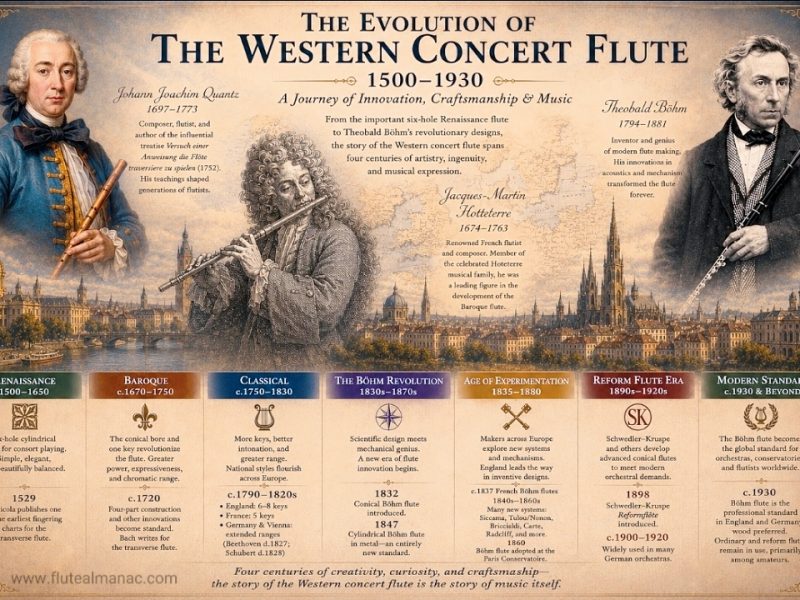
The history of the Western concert flute is a story of continuous innovation spanning more than four centuries. From the simple six-hole Renaissance flute to the sophisticated Böhm system used today, each generation of makers sought to improve tone, intonation, projection, technical facility, and musical expression.
Rather than evolving in a straight line, flute making developed through multiple national traditions and competing design philosophies. France, England, Germany, Austria, and Italy each contributed distinctive ideas that ultimately shaped the modern instrument.
This timeline highlights the major milestones, inventions, and historical developments that transformed the flute into the instrument we know today.
Renaissance Period (c.1500–1650)
The Renaissance Flute
The Renaissance flute was the dominant transverse flute of Europe from approximately 1500 until the mid-seventeenth century. It featured a narrow cylindrical bore, six finger holes, and no keys. Designed primarily for ensemble playing, it blended beautifully with voices and other soft instruments while retaining remarkable agility in its upper register.
Major Characteristics
- Cylindrical bore
- Six finger holes
- One-piece wooden construction
- Consort performance
- Meantone tuning
- Soft, blended tone
Important Milestones
1529 — Martin Agricola publishes one of the earliest fingering charts for the transverse flute.
The Baroque Revolution (c.1670–1750)
A New Instrument Emerges
Around 1670, the flute underwent its first major transformation. The Renaissance flute evolved into the Baroque flute, introducing a conical bore, a single key for the right-hand little finger, and a more refined multi-piece construction.
These innovations dramatically improved intonation, projection, and expressive possibilities, allowing the flute to become an important solo instrument.
France quickly became the center of Baroque flute making.
Major Innovations
- Conical bore
- One-key mechanism
- Improved intonation
- Greater projection
- Fully chromatic playing
- Richer and more expressive tone
Four-Piece Baroque Flutes
Around 1720, four-piece construction gradually replaced earlier three-piece designs.
This innovation made instruments easier to manufacture, maintain, and tune while allowing the introduction of interchangeable corps de rechange, enabling players to perform at different pitch standards.
Major Innovations
- Four-piece construction
- Corps de rechange
- Improved tuning flexibility
- Greater manufacturing precision
Important Figures
- Jacques-Martin Hotteterre
- Johann Joachim Quantz
- Thomas Lotz
- Jacob Denner
Important Composers
- Johann Sebastian Bach
- George Frideric Handel
- Johann Joachim Quantz
The Classical Period (c.1750–1830)
The Age of Keyed Flutes
During the Classical era, makers gradually added keys to improve intonation, eliminate difficult forked fingerings, and extend the instrument’s range.
Unlike later periods, there was no universal standard. Different countries developed their own preferred flute designs.
England
- Six-key flutes appear around 1755.
- Eight-key flutes later become the standard.
France
- Five-key flutes remain dominant.
Germany
- Nine-key flutes become increasingly common.
Vienna
- Extended-foot flutes reaching low G are developed.
Major Developments
- Increasing numbers of keys
- Improved intonation
- Brighter tone
- Greater technical facility
- Strong national schools of flute making
Important Composers
- Wolfgang Amadeus Mozart
- Joseph Haydn
- Ludwig van Beethoven
- Franz Schubert
The Böhm Revolution
1832 – The Conical Böhm Flute
In 1832, Theobald Böhm introduced one of the greatest revolutions in flute history.
His new flute featured acoustically positioned tone holes, ring keys, open-standing keys, and an entirely new fingering system. Although mechanically revolutionary, it still retained a conical bore and much of the tonal character of earlier flutes.
Major Innovations
- Acoustically positioned tone holes
- Ring-key mechanism
- Open-standing keys
- New fingering system
- Conical bore
1847 – The Cylindrical Böhm Flute
Fifteen years later, Böhm completed his revolutionary design by introducing the cylindrical Böhm flute.
This instrument became the direct ancestor of today’s modern concert flute.
Major Innovations
- Cylindrical body
- Parabolic headjoint taper
- Large tone holes
- Metal construction
- Modern acoustical design
The Great Age of Experimentation (1835–1880)
Alternative Systems Flourish
Although Böhm’s flute represented a major advance, many performers preferred the traditional fingering systems they already knew.
Across Europe, makers developed alternative flute systems that attempted to combine Böhm’s acoustics with traditional fingerings.
Important Systems
- French Böhm modifications
- Siccama System
- Tulou–Nonon System
- Briccialdi System
- Carte System (1851)
- Clinton Equisonant
- Pratten’s Perfected Flute
- Carte System (1867)
- Radcliff System
England became one of the world’s leading centers for experimental flute design during this period.
National Schools of Flute Making
France
France quickly embraced the Böhm flute.
In 1860, the Paris Conservatoire officially adopted the silver cylindrical Böhm flute, establishing what became known as the French Flute School.
England
English makers admired Böhm’s acoustics but often preferred alternative fingering systems.
As a result, numerous hybrid flute designs flourished throughout the nineteenth century.
Germany
Germany largely retained traditional conical-bore flutes for several decades.
Many performers preferred their darker, more blended orchestral sound over the brighter Böhm flute.
Reform Flutes (1898–1920)
The German Alternative
At the end of the nineteenth century, Maximilian Schwedler collaborated with Carl Kruspe to create the Reform Flute.
Rather than replacing the traditional German flute, the Reform Flute sought to preserve its characteristic sound while incorporating modern mechanical improvements.
Major Innovations
- Automatic venting systems
- Metal headjoint
- Improved intonation
- Greater projection
- Advanced key mechanisms
- Preservation of traditional German tone
Between approximately 1900 and 1920, Reform Flutes were widely used in German orchestras.
The Modern Concert Flute
Around 1930
By the early twentieth century, the Böhm flute had finally become the international professional standard.
Although simple-system and Reform flutes continued to be used by some musicians, the cylindrical Böhm flute ultimately prevailed because of its mechanical simplicity, consistent intonation, projection, and technical versatility.
Virtually every modern concert flute played today traces its lineage directly to Theobald Böhm’s 1847 design.
Timeline at a Glance
1500–1650
- Renaissance flute
- Cylindrical bore
- Six finger holes
- Consort instrument
1529
- Martin Agricola publishes early fingering charts.
c.1670
- Baroque flute introduced.
- Conical bore
- One-key system
c.1720
- Four-piece Baroque flute
- Corps de rechange
- Greater tuning flexibility
c.1755
- Six-key flutes appear in England.
c.1790
- Keyed flutes become increasingly common across Europe.
1820s
- National flute schools become firmly established.
- England: 8-key flutes
- France: 5-key flutes
- Germany: 9-key flutes
1832
- Theobald Böhm introduces the conical Böhm flute.
1847
- Böhm introduces the cylindrical flute that becomes the foundation of the modern concert flute.
1851
- Richard Carte introduces the Carte System flute.
1860
- Paris Conservatoire adopts the Böhm flute.
1867
- Carte System refined.
c.1870
- Radcliff System developed.
1885
- Schwedler begins developing new German flute designs.
1898
- Reform Flute introduced.
c.1900–1920
- Reform Flutes widely used in German orchestras.
c.1930
- Böhm flute becomes the international professional standard.
Explore Historical Categories
- Renaissance Flutes
- Baroque Flutes
- Classical Flutes
- Nineteenth-Century Keyed Flutes
- Theobald Böhm
- Böhm System Flutes
- English Hybrid Flutes
- Reform Flutes
- Historical Flute Makers
- Historical Headjoint Makers
- Historical Flute Accessories
- Historical Flutists & Legends