
Renaissance Flutes (c. 1500–1650)
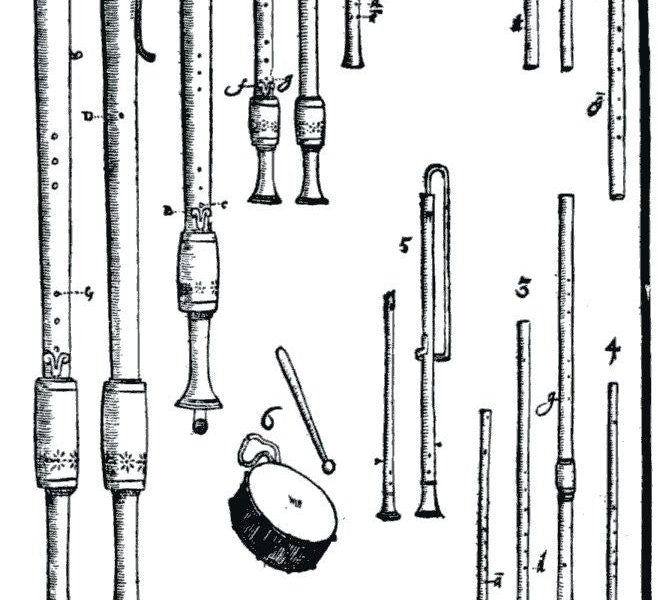
Overview
The Renaissance flute represents the earliest fully developed form of the European transverse flute and marks the beginning of a tradition that would eventually lead to the modern concert flute. Used from approximately 1500 to 1650, it played an important role in courts, churches, civic ensembles, military bands, and chamber music throughout Europe.
Unlike the later Baroque flute, which evolved into an expressive solo instrument, the Renaissance flute was designed primarily for ensemble playing. Its gentle, balanced tone blended naturally with voices and other instruments, making it ideally suited to the rich polyphonic music of the Renaissance.
Origins and Historical Development
Although transverse flutes had existed in Europe during the Middle Ages, the Renaissance witnessed the emergence of a standardized family of flutes built specifically for consort performance.
Instrument makers developed flutes in several sizes, each sharing similar proportions and tonal characteristics. Rather than emphasizing virtuosity, these instruments were intended to produce a unified, homogeneous sound across the entire ensemble.
This concept of the flute family became one of the defining characteristics of Renaissance wind instrument design and influenced the development of later recorder, crumhorn, and viol consorts.
Construction and Design
Renaissance flutes were generally constructed from hardwoods such as boxwood, maple, and fruitwoods.
Their principal features included:
- Cylindrical bore
- Six finger holes
- No keys
- One-piece construction on many early examples
- Small embouchure hole
- Relatively thick wooden walls
Compared with later Baroque flutes, Renaissance flutes possessed a simpler design with fewer mechanical refinements. Their narrow cylindrical bore produced a soft, pure, and remarkably blended tone rather than the projecting solo sound sought by later generations.
The Renaissance Flute Consort
The Renaissance flute was rarely played alone.
Instead, musicians performed in flute consorts, using complete families of instruments of different sizes.
The tenor flute in D became the most common member of the family, accompanied by descant, alto, bass, and occasionally larger instruments.
Rather than highlighting individual players, these ensembles emphasized balance, blend, and contrapuntal clarity — qualities perfectly suited to Renaissance polyphony.
Playing Characteristics
Unlike the modern Böhm flute, Renaissance flutes relied extensively on cross-fingerings, harmonic fingerings, and subtle embouchure adjustments.
Because of the instrument’s cylindrical bore and relatively small tone holes, many upper-register notes required specialized fingerings rather than simple octave overblowing.
These acoustical characteristics created a remarkably even and gentle sound throughout the instrument, while also giving individual notes subtle differences in tone color that performers used expressively.
Tuning and Musical Style
The Renaissance flute was designed for a musical world very different from modern equal temperament.
Most surviving instruments naturally favor meantone temperament, a tuning system that emphasized pure thirds and resonant harmonies.
As a result, notes such as F-sharp and G-flat were treated as distinct pitches rather than enharmonic equivalents, and performers adjusted intonation according to the harmonic context and the musical mode.
Understanding these tuning practices remains essential for historically informed performance today.
Historical Makers
Relatively few Renaissance flutes survive, but important instruments have been attributed to several notable makers and workshops.
Among the best known are:
- The Rafi Family (France and Italy)
- The Bassano Family
- Verona workshops
- Various anonymous workshops throughout Germany, France, England, and the Low Countries
These surviving instruments provide valuable insight into Renaissance craftsmanship, acoustical design, and historical performance practice.
Materials
Most Renaissance flutes were made from carefully selected hardwoods, including:
- Boxwood
- Maple
- Fruitwoods
- Other native hardwoods
Unlike later flutes, decorative metal fittings and complex key mechanisms were generally absent, reflecting both the musical aesthetics and practical construction methods of the period.
Legacy
The Renaissance flute occupies a unique place in the history of the instrument.
It established the foundations of the European transverse flute tradition and influenced every subsequent stage of flute development, including the Baroque traverso, the Classical flute, the simple-system flutes of the nineteenth century, and ultimately the Böhm flute.
Today, original Renaissance flutes are treasured by museums and collectors, while modern replicas play an essential role in historically informed performance around the world.
Their distinctive sound continues to bring the music of Josquin des Prez, Giovanni Gabrieli, William Byrd, Orlando di Lasso, Claudio Monteverdi, and many other Renaissance composers to life.
Types of Instruments
- Descant flutes
- Alto flutes
- Tenor flutes
- Bass flutes
- Renaissance flute consorts
- Military flutes and fifes
Materials
- Boxwood
- Maple
- Fruitwoods
- Other hardwoods
Characteristics
- Cylindrical bore
- Six finger holes
- No keys
- Meantone temperament
- Family-based consort design
- Soft, blended tone
- Designed primarily for ensemble performance
Legacy at a Glance
- Earliest fully developed European transverse flute.
- Foundation of the Renaissance flute consort tradition.
- Direct predecessor of the Baroque traverso.
- Established many of the acoustical and construction principles that influenced later flute development.
- Remains an essential instrument in historically informed performance.