
Godfroy Flutes
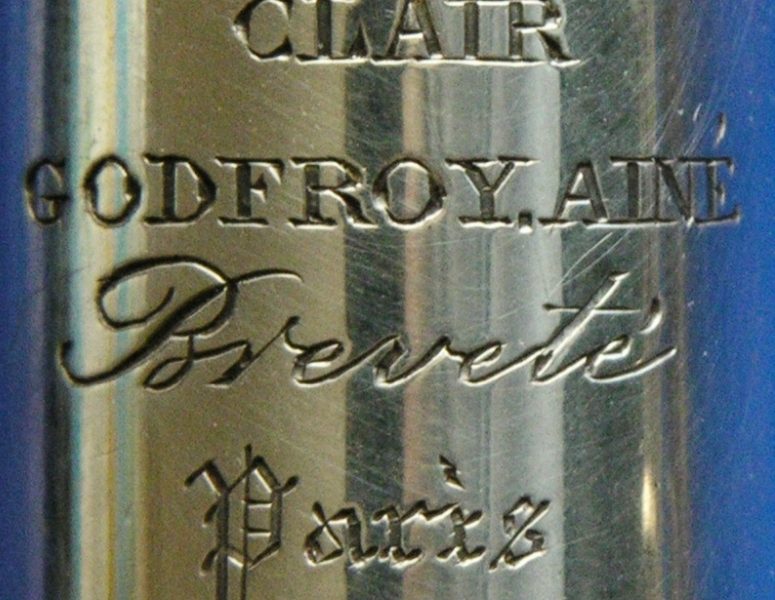
Godfroy (Clair Godfroy Aîné & the Godfroy Family) – France
Overview
The Godfroy family occupies a unique place in the history of flute making. Across five generations of instrument makers, the family played a central role in the evolution of both the traditional French simple-system flute and the early Böhm-system flute. Their workshops bridged two defining eras of nineteenth-century flute history, collaborating with leading performers, makers, and innovators at a time when the future of the flute was being fundamentally reimagined.
The most celebrated member of the family was Clair Godfroy Aîné (1774–1841), whose workshop became synonymous with exceptional craftsmanship, precision engineering, and elegant French design. Through his own work—and later through the partnership of his son Vincent Hypolite Godfroy and son-in-law Louis Lot—the Godfroy name became inseparable from the development of the modern concert flute.
Five Generations of Flute Makers
The Godfroy family originated in La Couture-Boussey, Normandy, one of France’s most important centers for woodwind instrument making.
Clair Godfroy Aîné, sometimes referred to as Clair Godfroy II, trained under his father before moving to Paris around 1800. Although he initially worked as both an instrument maker and dealer, he established his own workshop in 1814, producing a wide range of woodwind instruments.
The workshop quickly gained a reputation for building some of the finest French flutes of the nineteenth century, combining outstanding craftsmanship with elegant mechanical design and excellent tonal qualities.
The Godfroy Workshop
Although Godfroy produced many types of woodwind instruments, the workshop became particularly renowned for its flutes.
The firm manufactured:
- Traditional French simple-system flutes
- Multi-keyed conical flutes
- Ring-key Böhm flutes
- Cylindrical Böhm-system flutes
- Tulou Flûte Perfectionnée models
Surviving examples are admired for their refined workmanship, carefully finished mechanisms, elegant pointed-arm keys, and beautifully executed embouchures.
Concerned about counterfeit instruments, Clair Godfroy introduced a new workshop stamp in 1829, making his flutes more difficult to imitate. This distinctive hallmark appears on authentic instruments produced during the remainder of his career.
Collaboration with Jean-Louis Tulou
Long before becoming associated with Böhm-system flutes, the Godfroy workshop maintained a close relationship with the celebrated French flutist and Paris Conservatoire professor Jean-Louis Tulou.
Contemporary accounts describe Tulou testing Godfroy’s instruments, advising on their design, and helping improve tuning and mechanical refinement. According to nineteenth-century sources, Tulou’s endorsement alone was enough to establish a flute maker’s reputation, and Godfroy became one of the workshops most closely associated with France’s leading flutist.
The collaboration extended beyond traditional simple-system flutes. Godfroy also produced examples of Tulou’s Flûte Perfectionnée, demonstrating that the workshop actively participated in the final evolution of the French simple-system flute before the widespread adoption of the Böhm system.
The Godfroy–Lot Partnership
Clair Godfroy retired in 1836, leaving the workshop to his son Vincent Hypolite Godfroy (1806–1868) and his son-in-law Louis Esprit Lot (1807–1896), who had married Caroline Joséphine Godfroy.
The Godfroy–Lot partnership became one of the most influential collaborations in flute-making history.
In 1837, the workshop produced some of the earliest French commercial flutes based on Böhm’s 1832 ring-key design. Following the introduction of Böhm’s cylindrical flute in 1847, Godfroy and Lot became among the first licensed French manufacturers of the new system, helping establish what would later become known as the French model of the modern flute.
The partnership ended in 1854, when Louis Lot established his own workshop while Vincent Hypolite continued operating under the Godfroy name. Both firms would become internationally respected, together laying the foundations of the French School of flute making.
Between Two Worlds
Few workshops occupy such an important position in flute history.
The Godfroy workshop collaborated closely with Jean-Louis Tulou while simultaneously becoming one of the earliest French builders of Böhm-system flutes.
Rather than belonging exclusively to one school of thought, Godfroy served as a bridge between two competing visions of nineteenth-century flute making: the refinement of the traditional French simple-system flute and the revolutionary acoustical principles introduced by Theobald Böhm.
This unique position makes the Godfroy family indispensable to understanding the transition from the classical flute to the modern concert flute.
Design and Craftsmanship
Godfroy flutes are celebrated for their exceptional attention to detail.
Typical characteristics include:
- Elegant French styling
- Precisely fitted key mechanisms
- Pointed-arm key construction
- Carefully proportioned embouchure holes
- Excellent acoustical scaling
- High-quality exotic hardwoods
- Silver and German silver keywork
- Fine finishing and engraving
Both simple-system and Böhm-system instruments from the workshop demonstrate an unusually high standard of mechanical precision and artistic craftsmanship.
Legacy
Following Vincent Hypolite Godfroy’s death in 1868, the workshop continued under his widow until 1888, extending the family’s influence well into the late nineteenth century.
Today, the Godfroy name occupies a unique position in flute history. Few workshops contributed so significantly to both the final evolution of the French simple-system flute and the establishment of the modern Böhm flute.
Through its collaborations with Jean-Louis Tulou, its partnership with Louis Lot, and its pioneering work on Böhm-system instruments, the Godfroy family helped shape one of the most transformative periods in the history of flute making.
Surviving Godfroy instruments are highly prized by collectors, museums, historical performers, restorers, and researchers for their craftsmanship, historical significance, and remarkable musical qualities.
Materials
Godfroy workshops produced instruments using a variety of materials, including:
- Boxwood
- Cocuswood
- Grenadilla
- Ebony
- Ivory fittings (on some early instruments)
- Silver
- German silver
- Brass
Interesting Historical Connection
The Godfroy workshop stands at the center of one of the most fascinating networks in nineteenth-century flute making.
It collaborated with Jean-Louis Tulou, trained and partnered with Louis Lot, manufactured both Tulou Flûte Perfectionnée models and Böhm-system flutes, and helped establish the French tradition that later influenced makers including Haynes, Powell, Muramatsu, Brannen, Emanuel Flutes and many other modern builders.
Few names connect so many of the defining figures in flute history.
Notable Achievements
- Five generations of French woodwind and flute makers.
- Established the Paris Godfroy workshop in 1814.
- One of the earliest French workshops to adopt Böhm’s flute designs.
- Manufactured both traditional simple-system flutes and Böhm-system instruments.
- Collaborated closely with Jean-Louis Tulou and produced examples of the Flûte Perfectionnée.
- Among the first licensed French manufacturers of Böhm’s cylindrical flute.
- Formed the historic Godfroy–Lot partnership (1836–1854).
- Helped establish the French School of flute making.
- Produced some of the finest nineteenth-century French flutes, now prized by collectors and historical performers worldwide.