
Baroque Flutes (c. 1670–1800)
Baroque Flute (Traverso)
Overview
The Baroque flute, commonly known today as the traverso, was the principal transverse flute of the seventeenth and eighteenth centuries and one of the most influential instruments in the history of Western music. Developed during the second half of the seventeenth century, it transformed the Renaissance flute into a more refined, expressive, and technically versatile instrument capable of meeting the artistic demands of the Baroque era.
Its elegant tone, remarkable expressive flexibility, and intimate vocal quality made it one of the defining solo instruments of the eighteenth century. It inspired some of the greatest flute music ever written, including masterpieces by Johann Sebastian Bach, Georg Philipp Telemann, George Frideric Handel, Antonio Vivaldi, Jean-Marie Leclair, Michel Blavet, and Johann Joachim Quantz.
From Renaissance to Baroque
The Baroque flute evolved from the Renaissance transverse flute as musical tastes shifted toward greater expression, dynamic contrast, and harmonic sophistication.
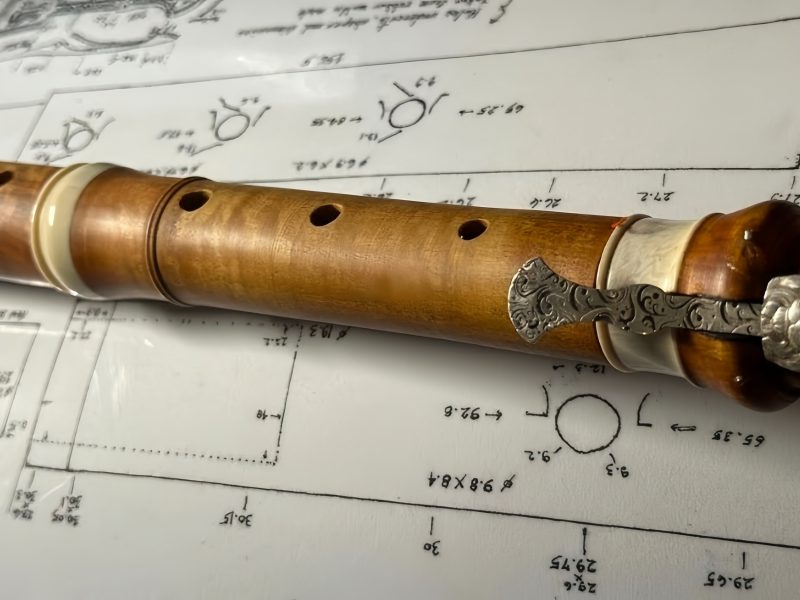
Instrument makers responded by redesigning the flute with a conical bore, a single key operated by the right-hand little finger, and a multi-section body. These innovations improved intonation, strengthened the lower register, enhanced tonal flexibility, and created the distinctive sound that became synonymous with Baroque music.
Unlike the Renaissance flute, which favored blended ensemble playing, the Baroque flute became an expressive solo instrument capable of subtle articulation, ornamentation, and rhetorical musical expression.
Construction and Design
Early Baroque flutes were generally constructed in three sections consisting of a headjoint, body, and footjoint.
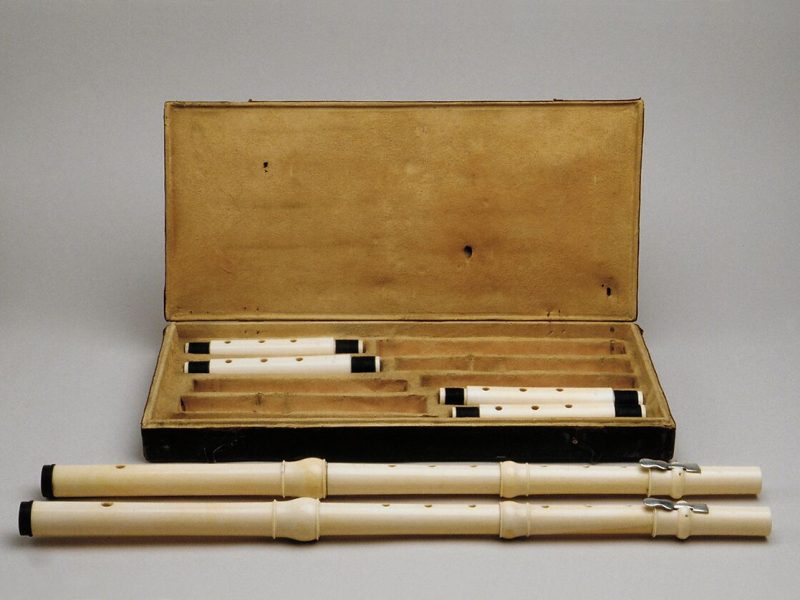
By the early eighteenth century, four-piece construction became standard. This allowed makers to introduce interchangeable middle joints, known as corps de rechange, enabling performers to adjust the instrument for the many different pitch standards used throughout Europe.
Typical characteristics included:
- Conical bore
- One-key mechanism
- Wooden construction
- Four-piece body (later models)
- Interchangeable tuning joints (corps de rechange)
- Range extending to low D (later C-foot models expanded the lower register)
Playing Characteristics
Unlike the modern Böhm flute, the Baroque flute relied extensively on cross-fingerings (forked fingerings) for chromatic notes.
Rather than producing perfectly uniform tone throughout the instrument, these fingerings created subtle variations in color, response, and resonance. Baroque musicians regarded these differences as expressive advantages rather than imperfections, using them to shape phrases and emphasize harmonic tension.
Its sound differs greatly from the modern concert flute:
- Warm, intimate lower register
- Vocal and expressive middle register
- Brilliant but elegant upper register
- Wide range of tonal colors
- Exceptional sensitivity to articulation and dynamics
These characteristics remain central to historically informed performance today.
Leading Makers
The Baroque flute reached remarkable levels of refinement through the work of several distinguished European makers.
Among the most influential were:
- The Hotteterre family (France)
- Pierre Naust (France)
- Jacob Denner (Germany)
- Thomas Lotz (Germany)
- Johann Joachim Quantz (Germany)
- C. A. Grenser (Germany)
- Thomas Stanesby Sr. and Jr. (England)
- Palanca (Italy)
- The Scherer family (Germany)
Each workshop developed subtle variations in bore design, key placement, dimensions, and tonal character, creating regional traditions that continue to influence historical performance.
Quantz and the Evolution of the Baroque Flute
Among all Baroque flute makers, Johann Joachim Quantz occupies a unique position.
Flutist, composer, teacher to Frederick the Great, and instrument maker, Quantz sought to improve the traditional Baroque flute without abandoning its musical character.
His innovations included:
- the famous two-key Quantz flute
- adjustable tuning mechanisms
- improved intonation
- greater flexibility for changing pitch standards
Although these developments represented significant advances, they remained firmly rooted in the Baroque flute tradition and anticipated later attempts to modernize the instrument during the Classical period.
Materials
Baroque flutes were constructed primarily from carefully selected hardwoods, including:
- Boxwood
- Grenadilla
- Ebony
- Cocuswood
- Fruitwoods (occasionally)
Many instruments were decorated with:
- Ivory mounts
- Horn rings
- Silver fittings
- Brass keys
The choice of material reflected both aesthetics and durability, while the instrument’s acoustical design remained the primary determinant of its sound.
Legacy
The Baroque flute defined flute performance for more than a century and established many of the musical traditions that continue to influence flutists today.
Its expressive capabilities inspired an extraordinary repertoire and shaped the development of flute technique long before the arrival of Classical and Böhm-system instruments.
Modern makers continue to build historically accurate replicas for performers specializing in historically informed performance, while original instruments remain among the most treasured examples of eighteenth-century craftsmanship found in museums and private collections around the world.
The Baroque flute stands as one of the great milestones in the evolution of the instrument, forming the essential bridge between the Renaissance flute and the Classical flutes of Quantz, Tromlitz, Meyer, and ultimately Theobald Böhm.
Countries
- France
- Germany
- England
- Netherlands
- Italy
Notable Historical Makers
- Hotteterre Family
- Pierre Naust
- Jacob Denner
- Thomas Lotz
- Johann Joachim Quantz
- C. A. Grenser
- Stanesby Family
- Palanca
- Scherer Family
Types of Instruments
- Three-piece Baroque flutes
- Four-piece Baroque flutes
- Corps de rechange flutes
- Quantz two-key flutes
- C-foot Baroque flutes
Materials
- Boxwood
- Grenadilla
- Ebony
- Cocuswood
- Ivory
- Horn
- Silver
- Brass
Legacy at a Glance
- Defined flute performance throughout the Baroque era.
- Established the foundation for Classical flute development.
- Inspired the innovations of Quantz, Tromlitz, Meyer, and later Böhm.
- Continues to play a central role in historically informed performance worldwide.