
Louis Lot
Louis Lot (1807–1896) – France
Overview
Few names occupy a more important place in the history of flute making than Louis Lot. Widely regarded as the greatest French flute maker of the nineteenth century, Lot transformed Theobald Böhm’s revolutionary ideas into instruments of extraordinary refinement that became the foundation of the modern professional flute.
Although Böhm invented the acoustical principles of the modern flute, it was Louis Lot who perfected many of those ideas through exceptional craftsmanship, mechanical refinement, and tonal development. His instruments established what became known as the French model of the Böhm flute and profoundly influenced nearly every major flute maker of the twentieth century.
Early Life and the Godfroy Partnership
Born in 1807 in La Couture-Boussey, France—the historic center of French woodwind making — Louis Lot learned instrument making from an early age.
In 1827, he joined the Paris workshop of Clair Godfroy Aîné, where he quickly became one of the firm’s most talented craftsmen. His marriage to Caroline Joséphine Godfroy made him both a member of the family and a business partner.
Following Clair Godfroy’s retirement in 1836, the workshop was managed jointly by Vincent Hypolite Godfroy and Louis Lot, creating one of the most important partnerships in nineteenth-century flute making.
Bringing Böhm’s Vision to France
The Godfroy–Lot workshop became one of the earliest French makers to embrace Theobald Böhm‘s revolutionary flute designs.
In 1837, they produced one of France’s first commercial Böhm ring-key flutes.
Following the introduction of Böhm’s cylindrical flute in 1847, Godfroy and Lot obtained the exclusive rights to manufacture the new design in France.
Rather than merely copying Böhm’s work, they refined its construction, improved manufacturing precision, and adapted the instrument to French musical aesthetics. Their efforts played a decisive role in establishing the Böhm flute as the future of professional flute performance.
Establishing the Louis Lot Workshop
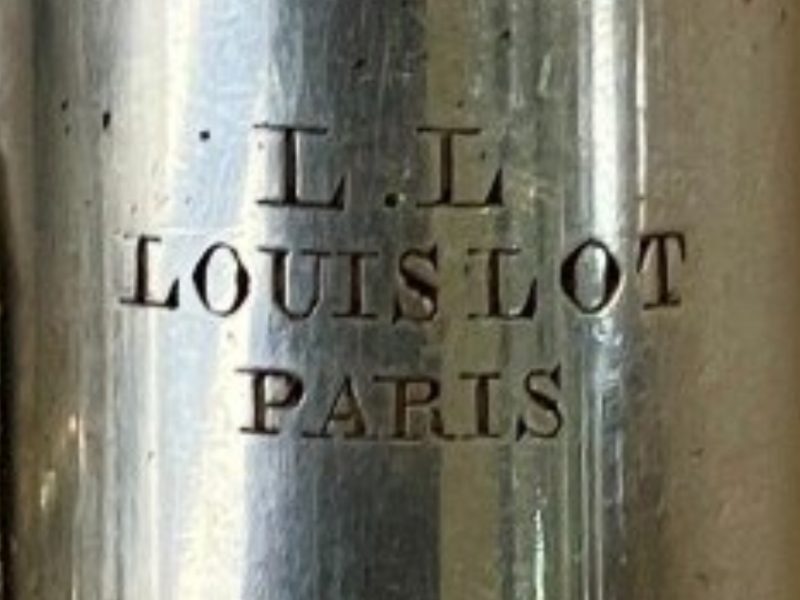
After the partnership dissolved in 1854, Louis Lot established his own Paris workshop under the famous stamp:
L.L. Louis Lot Paris
Over the following decades he devoted himself primarily to producing cylindrical Böhm-system flutes, continuously refining their:
- acoustical scale
- key mechanism
- embouchure design
- tone-hole dimensions
- mechanical precision
- tonal balance
Every generation of production shows subtle improvements, reflecting Lot’s constant pursuit of perfection rather than radical redesign.
Louis Dorus and the Paris Conservatoire
One of the most significant moments in flute history came in 1860, when Louis Dorus became Professor of Flute at the Paris Conservatoire.
Under Dorus, the Conservatoire officially adopted the Louis Lot Böhm flute, marking the final triumph of the Böhm system in France following decades of resistance led by Jean-Louis Tulou.
This decision established the Louis Lot flute as the principal instrument of the French flute school and influenced generations of performers.
The 1867 Universal Exposition
At the Paris Universal Exposition of 1867, Lot introduced a significantly refined flute incorporating:
- thicker tubing
- larger tone holes
- a larger embouchure
- stronger mechanism
- greater projection
- increased tonal flexibility
Many characteristics now associated with the modern professional flute can be traced directly to these refinements.
The Louis Lot Sound
Among flutists, the phrase “Louis Lot sound” has become almost legendary.
Original Louis Lot flutes are admired for their remarkable combination of:
- warmth
- projection
- flexibility
- colorful tone
- quick response
- singing lyrical quality
Even today, collectors and professional performers often describe a well-preserved Louis Lot flute as possessing an expressive quality that remains difficult to duplicate.
Materials and Craftsmanship
Louis Lot produced instruments using a variety of carefully selected materials, including:
- Solid silver
- Silver-plated nickel silver (maillechort)
- Grenadilla
- Ebony
- Cocuswood
Although best known for silver flutes, his workshop also produced exceptional wooden instruments during the transition from traditional simple-system flutes to the modern Böhm system.
Perhaps the most famous instrument ever produced by the workshop was No. 1375, completed in 1869 for Jean Rémusat.
Made entirely of 18-karat gold, it is believed to be the only fully solid-gold flute produced by Louis Lot. The instrument was later owned and performed by Jean-Pierre Rampal, making it one of the most celebrated flutes in history.
Influence on Modern Flute Making
Louis Lot’s influence extends far beyond the instruments he personally built.
Many of the world’s leading flute makers studied, copied, restored, or measured Louis Lot instruments when developing their own designs.
His work profoundly influenced makers including:
- Haynes
- Powell
- Brannen
- Muramatsu
- Sankyo
- Altus
- Yamaha
- Miyazawa
- Nagahara
- Burkart
- Emanuel Flutes and other numerous contemporary boutique makers
For many professional flute makers, the Louis Lot flute remains the historical benchmark against which modern instruments continue to be judged.
Legacy
Louis Lot retired in 1876, but his workshop continued under several successors, including Honoré Désiré Villette and later E. Barat.
The Louis Lot name remained active until the twentieth century before eventually becoming part of SML (Strasser-Marigaux-Lemaire).
Today, original Louis Lot flutes remain among the most desirable historical instruments in existence. Their exceptional craftsmanship, acoustical refinement, and historical significance continue to inspire performers, collectors, restorers, historians, and flute makers around the world.
Although Theobald Böhm invented the modern flute, Louis Lot perfected the instrument that became the model for the modern professional flute.
Materials
- Solid silver
- Silver-plated maillechort (nickel silver)
- Grenadilla
- Ebony
- Cocuswood
- Gold (rare special commissions)
Notable Achievements
- Partnered with the Godfroy workshop in developing France’s earliest Böhm-system flutes.
- Exclusive French manufacturer of Böhm’s cylindrical flute design (with Godfroy).
- Established the Louis Lot workshop in Paris in 1854.
- Official flute adopted by the Paris Conservatoire under Louis Dorus in 1860.
- Introduced important design refinements at the 1867 Paris Universal Exposition.
- Created the famous 18-karat gold flute for Jean Rémusat in 1869.
- Established the tonal and mechanical foundation of the French flute tradition.
- Influenced virtually every major professional flute maker of the twentieth and twenty-first centuries.