
Dorus G♯ Key
Overview
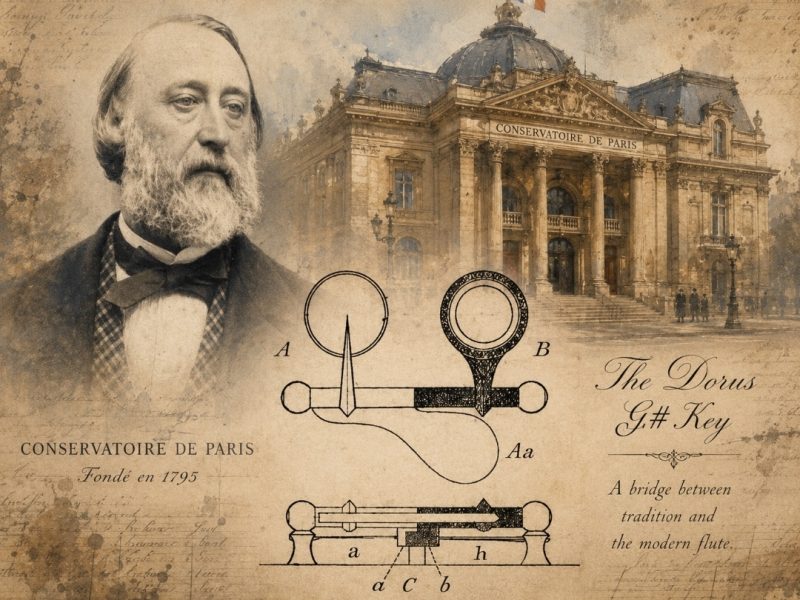
The Dorus G♯ Key is one of the most significant mechanical innovations in the history of the Böhm flute. Developed during the late 1830s by the French flutist Louis Dorus (1812–1896) in collaboration with the renowned Paris flute maker Louis Lot, it modified Theobald Böhm’s 1832 ring-key flute by replacing its original open-standing G♯ key with a closed-standing mechanism.
Although Böhm himself opposed the modification, the Dorus G♯ key played a decisive role in the acceptance of the Böhm flute in France and remained widely used for more than two decades before eventually being replaced by the modern closed G♯ mechanism.
Historical Background
When Theobald Böhm introduced his revolutionary ring-key flute in 1832, one of its most unusual features was the open-standing G♯ key. This arrangement followed Böhm’s logical mechanical philosophy, in which the movement of every key corresponded naturally to the movement of the fingers.
For flutists trained on the traditional simple-system flute, however, the open G♯ key required a completely new fingering approach. Many experienced players resisted the change, finding the new system unfamiliar despite the flute’s superior acoustics.
Among those seeking a compromise was the celebrated French virtuoso Louis Dorus, one of the earliest champions of the Böhm flute.
Working with Louis Lot, Dorus developed a new mechanism that restored the familiar closed G♯ fingering while preserving as much of Böhm’s acoustical design as possible.
The mechanism appeared on French Böhm flutes by approximately 1838 and was soon adopted by leading makers including Godfroy, Louis Lot, and Rudall & Rose.
How the Dorus G♯ Key Worked
The Dorus G♯ mechanism used two keys mounted on the same axle:
- a traditional closed-standing G♯ key operated by the left-hand little finger
- a ring key surrounding the A tone hole
Two opposing springs allowed the mechanism to function automatically.
When the ring finger covered the A hole, the G♯ key behaved like the familiar closed key found on simple-system flutes. When the finger was lifted, the mechanism automatically opened the G♯ vent, preserving the venting required by Böhm’s acoustical design.
Although mechanically more complex than Böhm’s original system, it allowed players trained on traditional flutes to transition more easily to the Böhm flute.
The Debate with Böhm
The Dorus G♯ key became one of the few modifications to Böhm’s design that its inventor openly criticized.
In an 1865 letter, Böhm argued that the closed G♯ key compromised:
- acoustical efficiency
- mechanical simplicity
- ease of playing
He believed the original open G♯ key was more logical because it followed the natural movement of the fingers and required fewer mechanical parts.
Böhm later wrote that he had initially remained silent out of respect for Louis Dorus, whom he greatly admired as one of Europe’s finest flutists.
Despite his objections, the Dorus system proved enormously influential.
Historical Importance
Although later replaced by the modern duplicate-hole closed G♯ mechanism around the 1860s, the Dorus G♯ key was instrumental in the spread of the Böhm flute throughout France.
It eased the transition for generations of flutists who were reluctant to abandon the fingering system of the traditional simple-system flute.
Without this compromise, the widespread acceptance of Böhm’s flute in France may have taken considerably longer.
Today, the Dorus G♯ key is regarded as one of the most important transitional mechanisms in flute history, illustrating how performers and makers adapted revolutionary ideas to meet the practical needs of musicians.
Legacy
- One of the earliest major modifications to Böhm’s flute
- Helped popularize the Böhm flute in France
- Bridged the transition between simple-system and Böhm-system flutes
- Predecessor of the modern closed G♯ mechanism
- One of the few flute mechanisms still widely known by its inventor’s name