
Rudall, Carte & Co.
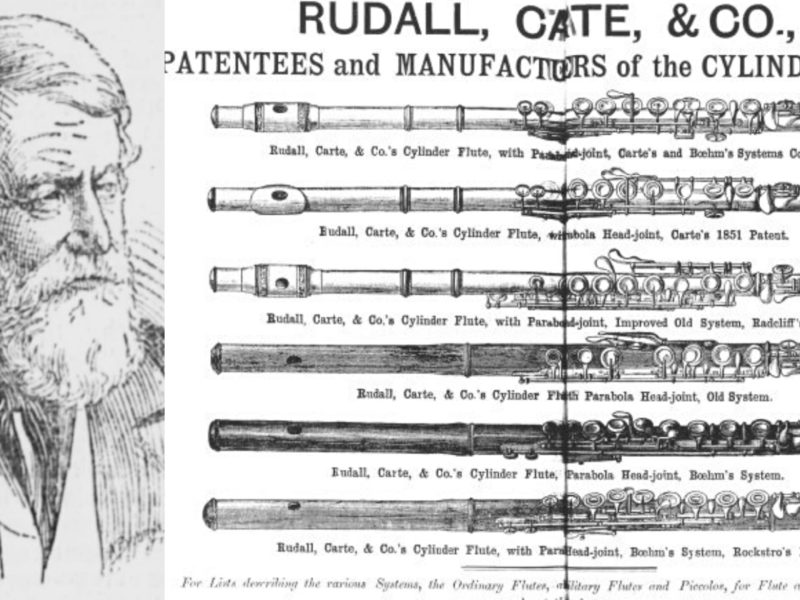
Rudall, Carte & Co. (1821–1943) – England
Overview
Rudall, Carte & Co. was one of the most influential flute manufacturers of the nineteenth century and played a central role in the development and dissemination of modern flute designs throughout Britain and the English-speaking world.
Founded in London as Rudall & Rose in 1821, the firm earned an international reputation for exceptional craftsmanship and became one of the leading advocates of modern flute design. Through its close association with Richard Carte, the company developed several important alternatives to the standard Böhm flute while continuing to manufacture traditional wooden flutes and Böhm-system instruments.
For much of the nineteenth century, Rudall, Carte & Co. stood at the crossroads between traditional British flute making and the emerging modern flute, helping shape the direction of flute performance throughout Britain and the British Empire.
Origins of the Company
The firm was established in 1821 by George Rudall (1781–1853) and John Mitchell Rose (1797–1877) in London.
Initially known as Rudall & Rose, the company quickly became respected for producing high-quality simple-system flutes and later embraced the rapidly changing world of nineteenth-century flute innovation.
As musical tastes evolved, the workshop expanded from traditional wooden flutes into increasingly sophisticated mechanical designs that reflected the changing demands of professional performers.
Even before Richard Carte joined the firm, Rudall & Rose had already established itself as one of the earliest manufacturers outside Germany to embrace Theobald Böhm’s revolutionary flute designs. During the 1830s and 1840s, the company became one of the first British makers to manufacture Böhm-system flutes under license, helping introduce the new instrument to English-speaking performers. This early commitment to Böhm’s acoustical principles positioned the firm at the forefront of nineteenth-century flute innovation and laid the foundation for the later development of the Carte System.
Richard Carte and a New Direction
A defining chapter in the company’s history began in 1850, when English flutist, inventor, publisher, and entrepreneur Richard Carte (1808–1891) joined the firm.
Carte admired Theobald Böhm’s revolutionary acoustical principles but believed the Böhm fingering system could be improved for many players accustomed to traditional British techniques.
Rather than rejecting Böhm’s work, Carte sought to combine its acoustical advantages with a mechanism that he considered more practical and technically efficient.
His work transformed the company into one of the world’s leading centers of flute innovation.
The Carte System Flutes
Introduced in 1851, the Carte System flute combined Böhm’s acoustical design with a newly developed key mechanism.
Its principal characteristics included:
- Fully vented mechanism
- Open-standing keys
- Open G-sharp system
- Carte’s innovative Open D mechanism
- Alternative fingering layout
- Powerful, resonant tone
Carte’s goal was to preserve the rich sound and projection of the Böhm flute while improving technical facility for performers trained on earlier systems.
The Carte 1867 System
Richard Carte continued refining his ideas throughout the following decades.
In 1867, he introduced the Carte 1867 System, incorporating numerous mechanical improvements that many performers regarded as one of the most technically advanced flute designs of the nineteenth century.
Although the standard Böhm system eventually became internationally dominant, the Carte System remained widely respected and attracted many distinguished performers.
The Radcliff System
Rudall, Carte & Co. also manufactured the Radcliff System flute, developed by English flutist John Radcliff (1843–1917).
Designed as a simplified alternative to the Böhm flute, the Radcliff System retained many familiar fingerings while adopting important Böhm acoustical principles.
It became particularly successful throughout Britain, Australia, and New Zealand and remained in professional use well into the twentieth century.
Instruments and Craftsmanship
The company produced an extensive range of instruments, including:
- Traditional simple-system flutes
- Böhm-system flutes
- Carte System flutes
- Radcliff System flutes
- Wooden flutes
- Metal flutes
Their instruments were exported throughout Europe, North America, Australia, New Zealand, India, and other parts of the British Empire, helping spread modern flute playing across the world.
Materials
Rudall, Carte & Co. worked with a wide variety of materials, including:
- Boxwood
- Grenadilla
- Cocuswood
- Silver
- Silver-plated metals
- Nickel silver
Their workshop produced both elegant wooden instruments and highly refined metal flutes, reflecting the transition from traditional craftsmanship to modern instrument making.
Philosophy and Innovation
Unlike many makers who simply adopted Böhm’s design, Richard Carte believed that innovation should remain practical for performers.
His instruments sought to combine:
- Böhm’s acoustical principles
- improved fingering efficiency
- mechanical reliability
- powerful tone
- technical flexibility
This philosophy produced some of the most successful alternative flute systems of the nineteenth century and demonstrated that the evolution of the modern flute was not limited to a single design.
Legacy
Rudall, Carte & Co. occupies a unique position in flute history.
The company preserved Britain’s rich flute-making tradition while simultaneously embracing modern acoustical innovation.
Although the standard Böhm system ultimately became the international standard, the Carte and Radcliff systems demonstrate that nineteenth-century flute makers continued exploring alternative solutions well into the late Victorian period.
Today, Rudall, Carte & Co. instruments remain highly prized by collectors, museums, restorers, historical performers, and researchers studying the evolution of the modern flute.
Founders
- George Rudall (1781–1853)
- John Mitchell Rose (1797–1877)
Key Figure
- Richard Carte (1808–1891)
Specialties
- Carte System flutes
- Carte 1867 System flutes
- Radcliff System flutes
- Böhm-system flutes
- Historical wooden flutes
- Metal flutes
- Hybrid nineteenth-century flute systems
Materials
- Boxwood
- Grenadilla
- Cocuswood
- Silver
- Silver-plated metals
- Nickel silver
Notable Innovations
- Carte 1851 System flute
- Carte 1867 System flute
- Open D mechanism
- Alternative Böhm-system fingering
- Combination of Böhm acoustics with traditional British playing principles
- Manufacture of the Radcliff System flute
Legacy at a Glance
- One of Britain’s most influential nineteenth-century flute manufacturers.
- Helped spread modern flute design throughout the British Empire.
- Creator of the celebrated Carte System flutes.
- Manufacturer of the successful Radcliff System flute.
- Important bridge between traditional British flute making and the modern Böhm flute.
Together with Godfroy & Lot in France, Rudall & Rose became one of the principal manufacturers responsible for spreading Böhm’s revolutionary ideas beyond Germany, ensuring that the modern flute quickly gained an international presence.