
Johann Joachim Quantz
Overview
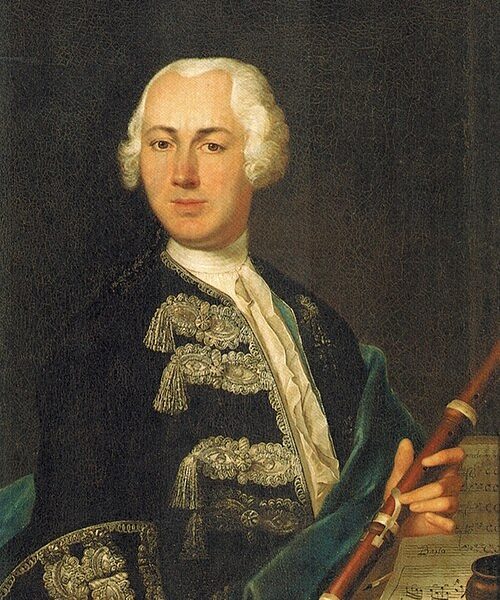
Johann Joachim Quantz was a German flutist, composer, flute maker, pedagogue, and one of the most influential figures in the history of the flute. Although celebrated during his lifetime as Europe’s finest flutist and the personal flute teacher of Frederick the Great of Prussia, his greatest legacy lies in his contributions to flute pedagogy, performance practice, and instrument design.
His landmark treatise, Versuch einer Anweisung die Flöte traversiere zu spielen (On Playing the Flute, 1752), remains one of the most important pedagogical works ever written for any musical instrument. Far more than a flute method, it presents a complete philosophy of musicianship, covering technique, ornamentation, articulation, phrasing, tone production, intonation, accompaniment, interpretation, and musical taste.
More than 270 years after its publication, it continues to be an essential reference for performers, teachers, musicologists, and specialists in historical performance.
Early Life and Musical Education
Johann Joachim Quantz was born on January 30, 1697, in Oberscheden, near Göttingen, Germany. His father was a blacksmith who intended his son to continue the family trade, but after his father’s death, Quantz was able to pursue music instead.
Like many German town musicians of the period, he received broad training on numerous instruments before eventually specializing in the transverse flute. He studied composition, counterpoint, and performance in Merseburg and Dresden, where he also worked with the distinguished composer Jan Dismas Zelenka. In 1719 he began studying the flute with Pierre-Gabriel Buffardin, principal flutist of the Dresden court orchestra.
Seeking to refine his artistry, Quantz undertook an extensive Grand Tour through Italy, France, England, and the Netherlands between 1724 and 1727. During these travels he studied with Francesco Gasparini, met Alessandro Scarlatti, became friends with Michel Blavet, and was encouraged by George Frideric Handel to remain in London. These experiences shaped his unique musical philosophy, combining the finest elements of Italian, French, and German traditions.
Teacher of Frederick the Great
In 1728 Quantz became flute teacher to Crown Prince Frederick of Prussia, who later became Frederick the Great.
When Frederick ascended the throne in 1740, Quantz accepted a permanent appointment in Berlin as the king’s flute teacher, composer, performer, and flute maker. He remained at the Prussian court for the rest of his life, composing hundreds of works specifically for Frederick while giving regular lessons and supervising musical performances.
His close relationship with the king allowed him an unusual degree of artistic independence and helped establish Berlin as one of Europe’s major musical centers during the eighteenth century.
Founder of Modern Flute Pedagogy
Quantz’s greatest historical contribution is undoubtedly his Versuch einer Anweisung die Flöte traversiere zu spielen (On Playing the Flute), published in 1752.
Unlike earlier flute tutors, the Versuch is not simply an instruction manual for fingerings or exercises. It is a comprehensive guide to becoming a complete musician. Quantz discusses:
- tone production
- embouchure
- breathing
- articulation
- ornamentation
- phrasing
- intonation
- tempo
- musical expression
- accompaniment
- ensemble playing
- improvisation
- composition
- performance etiquette
- instrument maintenance
One of Quantz’s most influential ideas was his concept of the “mixed taste” (vermischter Geschmack) — the artistic fusion of the best qualities of Italian expressiveness, French elegance, and German craftsmanship. This philosophy profoundly influenced eighteenth-century performance practice and remains central to historically informed performance today.
The Versuch also contains one of the earliest systematic discussions of double tonguing, expressive articulation, ornamentation, and stylistic interpretation.
Flute Maker and Innovator
Quantz was also an accomplished flute maker.
Seeking greater accuracy of intonation, he developed important improvements to the Baroque flute, most notably the addition of a second key to distinguish D-sharp from E-flat. This innovation reflected his belief that enharmonic notes should not always be treated as identical in tuning.
He built numerous flutes for Frederick the Great, many of which survive in museum collections today. Although his instruments were never widely copied commercially, they represent one of the most sophisticated stages in the evolution of the Baroque flute.
Composer
Quantz was among the most prolific flute composers of the eighteenth century.
Most of his music was written for his royal pupil and reflects both technical brilliance and elegant musical expression. His compositions bridge the late Baroque and emerging Classical styles while remaining ideally suited to the expressive capabilities of the traverso.
His works were admired by Johann Sebastian Bach, Joseph Haydn, and Wolfgang Amadeus Mozart and remain important repertoire for performers specializing in historical instruments.
Legacy
Few musicians have influenced flute playing as profoundly as Johann Joachim Quantz.
His treatise established many of the principles that continue to shape flute pedagogy, while his writings provide one of the clearest windows into eighteenth-century performance practice. His emphasis on musical expression, stylistic understanding, careful intonation, and artistic refinement elevated flute playing beyond mere technical display.
For performers of Baroque music, the Versuch remains an indispensable source. For flute teachers, it represents one of the earliest comprehensive philosophies of musical education. Through his teaching, compositions, flute designs, and scholarship, Quantz laid much of the intellectual foundation upon which later flute schools would build.
Selected Works
Pedagogical Works
Versuch einer Anweisung die Flöte traversiere zu spielen (On Playing the Flute, 1752) — One of the most influential instrumental treatises ever published. It remains the definitive eighteenth-century guide to flute playing, musicianship, ornamentation, interpretation, and historical performance practice.
Flute Concertos
- Approximately 300 flute concertos
- Several concertos for two flutes and orchestra
Sonatas
- More than 200 sonatas for flute and continuo
- Numerous sonatas for two flutes
Chamber Music
- Approximately 45 trio sonatas
- Six quartets for flute, violin, viola, and continuo
- Numerous flute duets and flute trios
Solo Flute Works
- Caprices
- Fantasias for unaccompanied flute
Contributions
- Author of one of the most influential flute methods in history
- Founder of systematic eighteenth-century flute pedagogy
- Teacher of Frederick the Great
- One of Europe’s greatest Baroque flutists
- Major composer of the Baroque flute repertoire
- Pioneer of historically informed performance principles
- Innovator in Baroque flute design and intonation
- Introduced the concept of the “mixed taste” combining Italian, French, and German musical traditions
- One of the earliest writers to explain articulation, ornamentation, phrasing, and expressive interpretation in detail
- Established pedagogical principles that continue to influence flute teaching more than 250 years later