
Ernesto Köhler
Overview
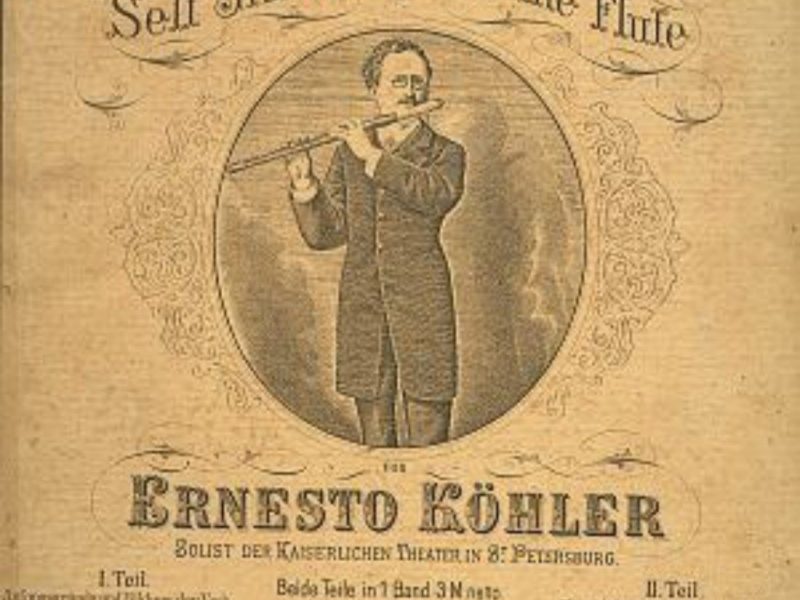
Ernesto Köhler (1849–1907) was an Italian-born flutist, composer, pedagogue, and author whose educational works have shaped flute teaching for well over a century. While he enjoyed an outstanding career as principal flutist of the Imperial Theatres in Saint Petersburg, his greatest contribution to musical history lies in the remarkable body of pedagogical literature he created for the flute.
More than almost any other nineteenth-century composer, Köhler devoted his career to developing progressive educational repertoire for students of every level. From complete beginners to advanced conservatory performers, his music provides a carefully structured path that develops technique, musicality, tone production, articulation, phrasing, expression, and virtuosity simultaneously.
Today, Köhler’s methods, études, duets, and concert works remain standard teaching materials in conservatories, universities, competitions, examinations, and private studios throughout the world, making him one of the most influential flute pedagogues in history.
Educational Philosophy
Köhler believed that technical development should never be separated from musical expression.
Rather than writing mechanical exercises alone, he created educational repertoire filled with memorable melodies, expressive Romantic character, and genuine musical beauty. Every technical challenge serves a musical purpose, encouraging students to develop artistry alongside technique.
Unlike many virtuoso composers whose music was intended only for advanced performers, Köhler carefully designed repertoire for every stage of learning. His publications allow students to progress naturally from elementary studies to concert-level virtuosity, making him one of the first composers to create a truly comprehensive educational system for the flute.
This philosophy remains one of the reasons his music continues to be studied by virtually every generation of flutists.
Flute Method
Around 1880 Köhler published his Flöten-Schule (Theoretical and Practical Flute School), one of the most important flute methods of the nineteenth century.
The method combines technical exercises, tone production, articulation, scales, musical interpretation, and progressive repertoire into a unified course of study. Adopted by numerous European conservatories, it helped standardize flute instruction during a period of enormous musical development and remains an important historical pedagogical resource.
Its influence can still be seen in modern flute teaching today.
Progressive Educational Repertoire
Perhaps Köhler’s greatest achievement was creating an exceptionally broad educational repertoire that accompanies students throughout their musical development.
His publications cover virtually every stage of flute study—from elementary technical exercises and lyrical character pieces to advanced virtuoso études and concert repertoire.
Unlike many educational composers, Köhler never sacrificed musical quality for technical instruction. His studies remain engaging, expressive, and rewarding to perform, which explains why they continue to occupy a central place in flute education more than a century after they were written.
Teachers around the world continue to rely on Köhler’s music because it develops technique through beautiful music rather than mechanical repetition alone.
Duets and Ensemble Playing
Köhler also made an enormous contribution to ensemble education.
His Forty Progressive Duets for Two Flutes remain among the finest educational duet collections ever written for the instrument. Carefully organized in progressive order, they introduce students to ensemble playing, intonation, phrasing, rhythm, articulation, listening skills, and musical collaboration while remaining enjoyable to perform.
These duets continue to be used by teachers worldwide and have introduced generations of young flutists to chamber music.
Composer
Although best known today for his educational works, Köhler was also a prolific composer of concert repertoire.
He composed more than one hundred works for the flute, including concertos, fantasies, salon pieces, chamber music, vocal works, and orchestral compositions. His music combines Italian lyricism with the expressive richness of Russian Romanticism, creating works that are both technically satisfying and musically appealing.
His opera Ben Achmed and ballet Clorinda, Queen of the Mountain Fairies enjoyed considerable success during his lifetime, while many of his concert pieces remain favorites among flutists today.
Enduring Legacy
Few composers have exercised a greater practical influence on flute education than Ernesto Köhler.
For well over one hundred years, countless flutists have taken their first musical steps through his studies, developed technique through his exercises, refined musicianship through his lyrical pieces, and advanced toward virtuoso repertoire with his concert works.
His publications remain among the most widely studied educational works in the flute literature and continue to serve as an essential bridge between elementary instruction and advanced artistic performance.
More than a century after his death, Ernesto Köhler stands as one of the founding figures of modern flute pedagogy, whose music continues to inspire teachers and students throughout the world.
Selected Works
Flute Methods
- Theoretisch-Praktische Flötenschule (Theoretical and Practical Flute School) (2 vols.)
Progressive Studies & Études
- Der Fortschritt im Flötenspiel (Progress in Flute Playing), Op. 33
- Forty Progressive Duets for Two Flutes, Op. 55
- Twenty-Five Romantic Études, Op. 66
- Thirty Virtuoso Études in All Major and Minor Keys, Op. 75
- School of Velocity (Daily Studies), Op. 77
- 22 Exercises for Technique and Interpretation, Op. 89
- 20 Easy Melodic Progressive Lessons, Op. 93
- Twenty-Four Characteristic Études
Concert Works for Flute and Orchestra
- Shepherd’s Idyll (Hirten-Idylle), Op. 58
- Concert Fantasia on a Russian Folk Song (Moskwa), Op. 62
- Concert Fantasia on Themes from Der Gouverneur von Tours, Op. 64
- Flight of the Swallows (Schwalbenflug), Op. 72
- La Romantique, Concert Fantasy, Op. 80
- Zephyr, Concert Waltz, Op. 81
- Fantasia, Concert Piece, Op. 91
- La Capriccieuse, Concert Piece, Op. 94
- Flute Concerto in G Minor, Op. 97
- Second Flute Concerto, Op. 99 (unfinished)
Flute and Piano
- Il Tramonto del Sole, Op. 2
- Reminiscenze Belliniane, Op. 3
- Fantaisie Romantique, Op. 13
- Bon Soir, Romance, Op. 27
- Six Brilliant Pieces, Op. 30
- Frühlingslied (Spring Song), Op. 38
- Tarantelle Napolitaine, Op. 42
- Danse Champêtre, Op. 43
- Kuss-Gavotte, Op. 47
- Reverie Poétique, Op. 49
- Auf den Alpen (On the Alps), Op. 51
- Dance Album, Op. 53
- Valse Espagnole, Op. 57
- Serenade, Op. 59
- Six Salon Pieces, Op. 60
- Six Easy Fantasias on Russian Folk Songs, Op. 61
- Six Easy Fantasias on German Folk Songs, Op. 63
- Oriental Serenade, Op. 70
- Valse Mignon, Op. 71
- Concert Fantasia on a Theme by Donizetti, Op. 73
- Italian Serenade, Op. 74
- At the Seashore, Op. 76
- Three Characteristic Pieces, Op. 78
- Dream of the Future (Zukunftstraum), Op. 79
- Ten Concert Études, Op. 82
- Six Solo Pieces (Vortragsstücke), Op. 84
- The Pearl of the North (La Perle du Nord), Op. 86
- Four Morceaux Caractéristiques, Op. 88
- Love in Idleness, Op. 90
- Concert Fantasia on Ruslan and Lyudmila, Op. 95
- Concert Fantasia on A Life for the Tsar, Op. 96
Chamber Music
- Grand Quartet for Four Flutes, Op. 92
- First Concert Duet on a Melody by Schubert, Op. 67
- Second Concert Duet on a Melody by Chopin, Op. 68
- Flower Waltz, Op. 87
- Echo, Op. 40
- Echo, Concert Aria for Soprano, Flute and Piano, Op. 69
- The Well, Op. 83
- Au Vol d’Oiseau, Op. 98
Stage Works
- Ben Achmed (Opera)
- Clorinda, Queen of the Mountain Fairies (Ballet)
Contributions
- One of the most influential flute pedagogues in history
- Author of one of the nineteenth century’s most important flute methods
- Created one of the most comprehensive progressive educational repertoires for the flute
- Composed more than 100 works for the instrument
- Developed pedagogical music for every level, from beginner to virtuoso
- Wrote one of the finest collections of educational flute duets
- Helped establish systematic flute instruction in conservatories
- Combined technical development with expressive musical artistry
- His methods and études remain standard teaching materials throughout the world
- Left one of the most enduring educational legacies in the history of the flute