
Marcel Moyse
Overview
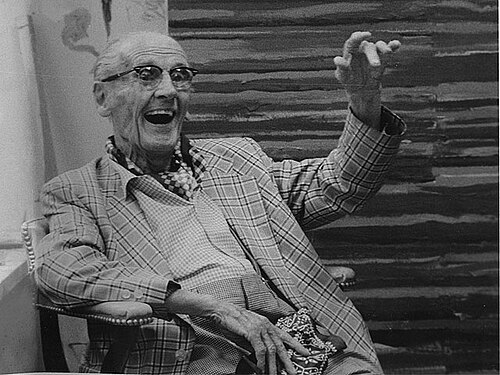
Marcel Moyse was one of the most influential flutists, pedagogues, and authors in the history of the instrument. A student of Paul Taffanel, Adolphe Hennebains, and Philippe Gaubert, he became the greatest ambassador of the French Flute School during the twentieth century, shaping generations of performers through his artistry, teaching, recordings, and pedagogical publications.
Renowned for his luminous tone, expressive phrasing, and uncompromising musical ideals, Moyse believed that technique existed only to serve artistic expression. His teaching transformed flute education worldwide, and his books remain standard studies in conservatories and professional studios more than ninety years after their publication.
Early Life and Education
Marcel Moyse was born on May 17, 1889, in Saint-Amour, France. After moving to Paris as a child, he studied first with Adolphe Hennebains before entering the Paris Conservatoire, where he worked with Paul Taffanel and later continued private studies with Philippe Gaubert.
In 1906, after only one year at the Conservatoire, Moyse won the Premier Prix, becoming one of the youngest flutists ever to achieve this distinction.
Performance Career
Moyse quickly established himself among France’s leading orchestral and solo flutists. Throughout his career he served as principal flutist with several of Paris’s most prestigious ensembles, including:
- Orchestre de la Société des Concerts du Conservatoire
- Opéra-Comique
- Paris Opera
He also toured internationally as a soloist and chamber musician, performing with many of the leading musicians of his era. In 1913 he toured the United States with legendary soprano Nellie Melba, while later collaborations included performances with Nadia Boulanger, Arturo Toscanini, and the Moyse Trio, founded with his wife Blanche and son Louis Moyse.
His recordings remain among the most important historical documents of twentieth-century flute performance.
Teacher and Founder of Modern Flute Pedagogy
In 1932, Moyse succeeded Philippe Gaubert as Professor of Flute at the Paris Conservatoire, continuing the pedagogical lineage established by Taffanel.
He later taught at the Geneva Conservatory before settling in the United States, where he co-founded the Marlboro Music School and Festival in Vermont, one of the most influential centers for chamber music education.
Moyse frequently explained that he wished to teach students not simply how to play the flute, but how to make music. His lessons focused on expressive phrasing, beautiful tone, musical language, breathing, and communication rather than mechanical technique alone.
Teaching Philosophy
Marcel Moyse’s teaching centered on musical expression. Among his most enduring principles were:
- Developing a luminous, singing tone.
- Understanding phrase direction and musical architecture.
- Making the hierarchy of beats clearly audible.
- Studying articulation through language rather than mechanics.
- Learning expression from singers and string players.
- Treating vibrato as a natural extension of musical expression rather than a technical device.
- Respecting historical performance traditions while maintaining artistic freedom.
His philosophy continues to influence flute teaching throughout the world.
Legacy
Few musicians have shaped flute playing as profoundly as Marcel Moyse.
Through his teaching, recordings, publications, and masterclasses, he became the direct link between the nineteenth-century French flute tradition and modern performance practice. His influence extends across virtually every major flute school worldwide.
Among his many distinguished students were:
- Sir James Galway
- Trevor Wye
- Paula Robison
- William Bennett
- Carol Wincenc
- Bernard Goldberg
- Robert Aitken
- Karen Reynolds
- Julia Bogorad
Today, the Marcel Moyse Society, annual festivals, masterclasses, recordings, and countless teachers continue preserving and expanding his artistic legacy.
Selected Publications
Marcel Moyse authored some of the most influential pedagogical works ever written for flute.
Tone Development
- De la Sonorité (1934) — universally regarded as one of the greatest books ever written on flute tone production.
- Tone Development Through Interpretation — develops tone, phrasing, and musical expression through repertoire.
Daily Technique
- Gammes et Arpèges (Scales and Arpeggios)
- Exercices Journaliers (1922)
- 25 Études Journalières
- Mécanisme-Chromatisme (1927)
Articulation and Technique
- École de l’Articulation (1927)
- 20 Exercices et Études sur les Grandes Liaisons
- Le Débutant Flûtiste (1935)
Studies and Études
- Études et Exercices Techniques (1921)
- 25 Études Mélodiques
- 24 Petites Études Mélodiques
- 20 Études d’après Kreutzer
- 24 Caprices-Études d’après Boehm, Op. 26
- 24 Études de Virtuosité d’après Czerny
- 12 Études de Grande Virtuosité d’après Chopin
- 48 Études de Virtuosité (Books I & II)
Historical Importance
Marcel Moyse represents one of the defining figures in modern flute history. Building upon the foundations established by Paul Taffanel and Philippe Gaubert, he transmitted the French Flute School to the international community through his teaching, publications, recordings, and students.
His concept of beautiful tone, expressive phrasing, and musical communication remains one of the cornerstones of professional flute performance in the twenty-first century.