
J. H. Zimmermann
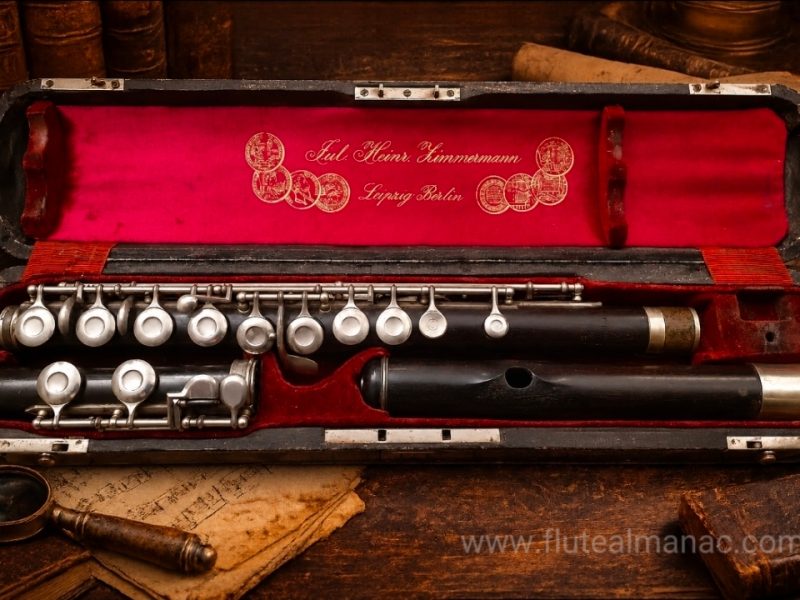
Overview
Founded by Julius Heinrich Zimmermann in St. Petersburg, Russian Empire, in 1875, and relocated to Leipzig, Germany, in 1886, J. H. Zimmermann became one of Europe’s largest and most influential musical instrument manufacturers.
While the company produced a wide range of instruments, it earned particular distinction for its high-quality German conical-system flutes, preserving and refining a tradition that continued alongside the widespread adoption of the Böhm flute.
Through an international network of branches in Leipzig, St. Petersburg, Moscow, Riga, and London, Zimmermann supplied instruments to musicians throughout Europe and the Russian Empire, becoming one of the best-known names in late nineteenth-century German flute making.
Historical Development
Unlike France and England, where the Böhm flute rapidly became the professional standard, many German flutists remained faithful to the traditional wooden conical flute. They valued its warm, nuanced tone, familiar fingering, and expressive qualities, believing it better suited the German orchestral tradition.
Zimmermann embraced both worlds. The firm’s extensive catalogs offered Böhm-system flutes alongside an impressive variety of traditional conical flutes, ranging from simple student instruments to highly sophisticated professional models with as many as fifteen keys. This broad selection allowed musicians to choose instruments according to their technical level and artistic preferences.
Instruments and Innovations
Zimmermann became especially renowned for the Modell Zimmermann, one of the most celebrated German reform flutes of the late nineteenth century. Closely related to the Schwedler-Kruspe flute, it incorporated numerous mechanical refinements while preserving the tonal character of the traditional conical flute.
Professional models featured advanced multi-key systems, improved trill mechanisms, excellent intonation, quick response, and a large, full tone.
The company also produced Meyer-style, Viennese-style, and other German old-system flutes, as well as imported Böhm flutes from leading French manufacturers.
By the end of the nineteenth century, Zimmermann catalogs classified flutes for students, amateur orchestras, and professional virtuosi, illustrating the remarkable diversity of flute playing that still existed during this transitional period.
The Köhler Connection
The distinguished flutist and composer Ernesto Köhler (1849–1907) publicly endorsed the Modell Zimmermann flute in the firm’s catalog. He praised its easy response, pure intonation, large, full tone, and its innovative mechanism that enabled the difficult high G”’–A”’ trill.
Zimmermann also published Köhler’s influential Flöten-Schule, further strengthening the company’s reputation among German-speaking flutists and helping establish the Modell Zimmermann as one of the leading professional conical flutes of its era.
Materials
Zimmermann flutes were produced using carefully selected materials, including:
- Grenadilla
- Cocuswood
- Ebony
- Boxwood
- Silver-mounted keywork
- Nickel silver mechanisms
- Brass-lined tuning slides on selected models
- Ivory fittings on luxury instruments
The firm’s instruments were admired for their precise workmanship, durable mechanisms, and elegant finishing.
Historical Significance
J. H. Zimmermann represents one of the final and most sophisticated chapters in the evolution of the German conical flute. While French makers such as Louis Lot perfected the Böhm flute, Zimmermann continued developing highly refined wooden conical instruments for musicians who preferred the traditional German sound and playing style.
The company’s flutes demonstrate that the transition to the modern Böhm system was gradual rather than universal, with multiple flute traditions coexisting well into the twentieth century.
Legacy
Today, original Zimmermann flutes remain highly valued by collectors, museums, restorers, and performers specializing in historical performance. Their exceptional craftsmanship, mechanical sophistication, and distinctive tonal qualities preserve an important chapter in the history of German flute making and the evolution of the nineteenth-century flute.
Notable Achievements
- Founded one of Europe’s largest musical instrument manufacturers
- Preserved and refined the German conical flute tradition
- Produced the celebrated Modell Zimmermann
- Manufactured professional flutes with up to fifteen keys
- Distributed instruments throughout Europe and the Russian Empire
- Published and promoted Ernesto Köhler’s flute works and methods
- Helped preserve German old-system flute playing into the twentieth century