
Schwedler Flutes (1885 & 1895)
Overview
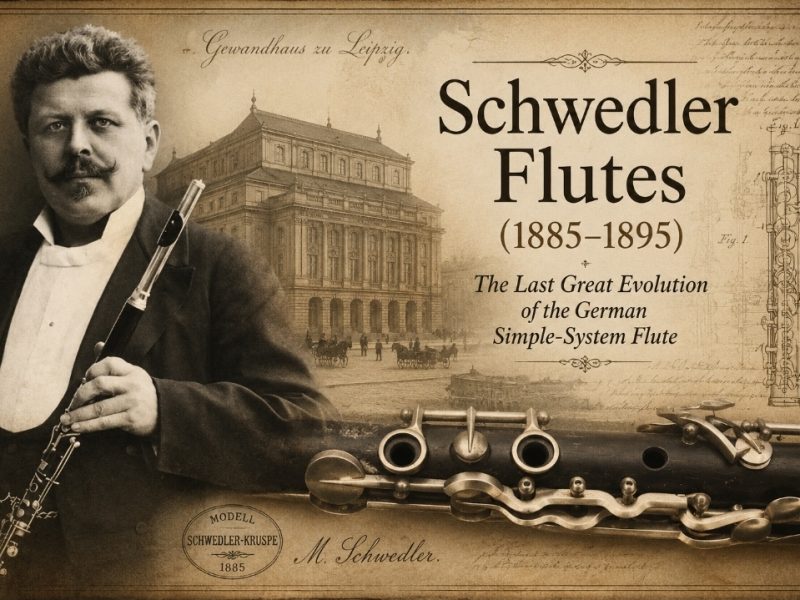
The Schwedler Flute was developed by German flutist Maximilian Schwedler (1853–1940) in collaboration with F. W. Kruspe and later Carl Kruspe. Introduced in 1885 and further refined in 1895, it represented one of the most significant attempts to modernize the traditional German simple-system flute while preserving its characteristic conical bore, warm tone, and familiar fingering.
Unlike the later Reform Flute introduced in 1898, the Schwedler Flute remained fundamentally a simple-system flute. Its innovations focused on improving tone production, mechanical reliability, intonation, and technical facility without abandoning the musical qualities that many German musicians believed distinguished the conical flute from the Boehm system.
Today, the Schwedler Flute is regarded as one of the most important milestones in late nineteenth-century flute making and as the direct predecessor of the Schwedler-Kruspe Reform Flute.
Historical Background
Maximilian Schwedler served as principal flutist of the Leipzig Gewandhaus Orchestra from 1881 until 1917 and taught for decades at the Leipzig Conservatory.
Although he recognized the technical advantages of the Boehm flute, Schwedler believed the traditional wooden conical flute possessed a richer, darker, and more expressive tone. Rather than replacing it, he sought to modernize it.
Working first with F. W. Kruspe in Erfurt and later with Carl Kruspe in Leipzig, Schwedler developed two important models:
- Schwedler-Kruspe Model 1885
- Schwedler-Kruspe Model 1895
These instruments became widely respected throughout Germany and strongly influenced many later makers.
The 1885 Model
The 1885 model introduced numerous mechanical improvements while preserving the traditional simple-system fingering.
Its principal innovations included:
- Redesigned three-piece construction
- Modern axle and needle-spring mechanism
- The distinctive Schwedler embouchure (Schwedler-Mundloch) with raised side cusps
- New trill keys for difficult upper-register passages
- Refined bore design for a fuller, more powerful tone
- Improved low register projection
Importantly, the six principal finger holes remained directly under the fingers, meaning the instrument still qualified as a true simple-system flute.
The Schwedler Embouchure
One of Schwedler’s best-known innovations was the Schwedler-Mundloch, an embouchure with small raised “cusps” on each side.
Schwedler believed this design improved response, strengthened tone production, and provided greater stability. While opinions differed regarding its musical advantages, the Schwedler embouchure became widely adopted by German makers and appeared on many instruments well into the twentieth century.
The 1895 Model
In 1895 Schwedler introduced a more advanced version incorporating two important ring-key mechanisms:
C♯ Brille
The C♯ Brille used interconnected ring keys to improve the intonation and response of C♯ while preserving the traditional fingering system.
F♯ Brille
The F♯ Brille introduced an additional venting system that sharpened F♯ automatically, greatly improving one of the long-standing weaknesses of nineteenth-century simple-system flutes.
These mechanisms represented a significant step toward more acoustically optimized flute designs while remaining compatible with traditional technique.
Sound Characteristics
Compared with earlier German simple-system flutes, the Schwedler Flute produced:
- a fuller, warmer tone
- stronger projection in the low register
- improved balance between registers
- more reliable intonation
- smoother technical operation
Unlike many contemporary English designs, Schwedler deliberately avoided very large tone holes or radical changes to the traditional fingering.
Materials:
The body remained wooden with a conical bore, but the headjoint was not always wooden.
1885 Model: usually a wooden body with either an ivory or wooden headjoint, depending on the maker and period.
1895 Model: still fundamentally a wooden conical flute, though examples with wooden heads continued.
After 1898, on the Reform Flute, the metal headjoint became a standard feature.
There were also later Schwedler-style instruments by makers such as Kohlert and Zimmermann that combined Schwedler mechanisms with metal headjoints, even though they were not Reform Flutes.
Reception
The Schwedler Flute was warmly received by many leading German musicians.
After hearing Schwedler perform on the new instrument during the Leipzig premiere of his Fourth Symphony in 1886, Johannes Brahms praised its “full-bodied, beautiful, and powerful tone.”
Numerous German makers adopted some or all of Schwedler’s innovations, and variants of the design remained popular well into the early twentieth century.
Legacy
The Schwedler Flute represents one of the final and most sophisticated developments of the traditional German simple-system flute.
Its mechanical innovations directly led to the creation of the Schwedler-Kruspe Reform Flute of 1898, which expanded these ideas into an entirely new system.
Today, Schwedler instruments remain important historical examples of Germany’s unique approach to flute making during a period when much of Europe was adopting the Boehm system.
Maximilian Schwedler’s Honors and Recognition
Honorary Knight’s Cross of the Order of Albrecht (1908) – awarded in recognition of his contributions to German musical life.
Honorary title of Royal Chamber Virtuoso (Königlicher Kammervirtuose) (1917) – conferred upon his retirement after 36 years as principal flutist of the Leipzig Gewandhaus Orchestra.
Praised by Johannes Brahms (1886) following the Leipzig premiere of Brahms’ Fourth Symphony, who specifically admired the “full-bodied, beautiful, and powerful tone” of Schwedler’s new flute.
Carl Reinecke dedicated his Flute Concerto, Op. 283 (1908) to Maximilian Schwedler, reflecting his standing among Germany’s leading flutists.