
Johann Joachim Quantz
Overview
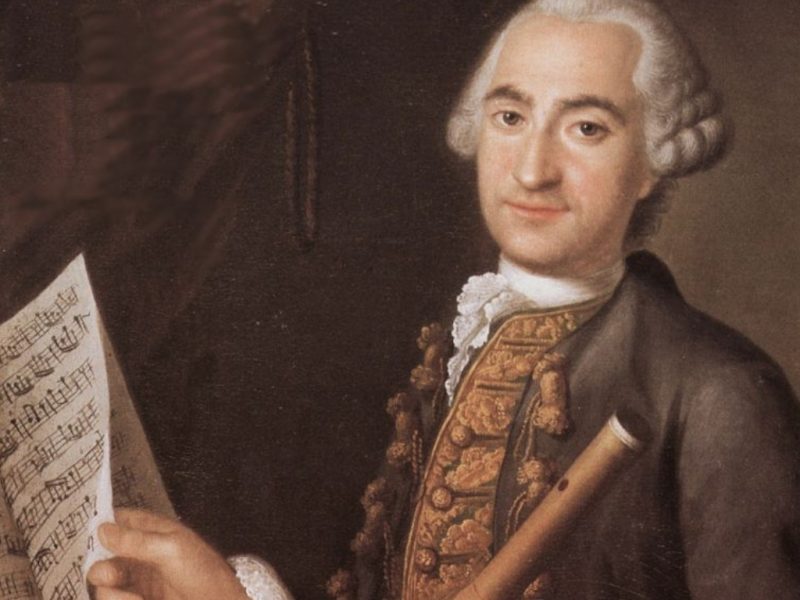
Johann Joachim Quantz was one of the greatest flutists of the eighteenth century and one of the first true international flute virtuosos.
Admired throughout Europe for his refined musicianship, expressive playing, and technical mastery, he helped establish the transverse flute as a respected solo instrument during the late Baroque period.
His performances earned the admiration of many of Europe’s leading composers and musicians, including Johann Sebastian Bach, George Frideric Handel, and later generations represented by Haydn and Mozart.
As court musician, composer, flute maker, and personal flute teacher to Frederick the Great of Prussia, Quantz became one of the central musical figures of the German Enlightenment.
Although remembered today for his famous treatise On Playing the Flute, Quantz’s reputation during his lifetime rested equally on his extraordinary abilities as a performer.
Early Career
Quantz received a broad musical education, studying numerous instruments before choosing the transverse flute as his principal instrument around 1719 under the guidance of Pierre-Gabriel Buffardin in Dresden.
His remarkable talent quickly attracted attention, and he became one of the leading musicians of the Dresden court, then regarded as one of Europe’s finest musical establishments.
European Grand Tour
Between 1724 and 1727 Quantz undertook an extended educational journey through Italy, France, England, and the Netherlands.
During these travels he studied with Francesco Gasparini, met Alessandro Scarlatti, became a close colleague of Michel Blavet, and was encouraged by George Frideric Handel to remain permanently in London. Instead, Quantz returned to Dresden, bringing together the finest elements of Italian virtuosity, French elegance, and German craftsmanship into his own distinctive style.
This international experience made him one of the most cosmopolitan flutists of his generation.
Europe’s Leading Flutist
By the late 1720s Quantz was widely regarded as one of Europe’s foremost flute virtuosos.
His playing was celebrated for:
- refined tone
- expressive phrasing
- elegant ornamentation
- exceptional technical facility
- beautiful cantabile style
- impeccable musical taste
Rather than relying solely on virtuosity, Quantz emphasized expressive communication and stylistic refinement. His performances reflected the ideal of the complete musician, balancing technical brilliance with elegance and emotional depth.
His reputation eventually brought him to the attention of Crown Prince Frederick of Prussia, whose passion for the flute would shape the remainder of Quantz’s career.
Court Musician to Frederick the Great
In 1741 Quantz entered the service of Frederick the Great in Berlin.
Unlike most court musicians, Quantz enjoyed extraordinary privileges. He served as the king’s personal flute teacher, composed hundreds of concertos and sonatas specifically for Frederick, performed regularly in the famous evening concerts at Sanssouci Palace, and supervised many aspects of the king’s musical life.
His position allowed him to influence both royal musical taste and the development of flute performance throughout Europe.
Musical Style
Quantz believed that the finest music combined the strengths of several national traditions.
His own playing embodied what he called the “mixed taste,” blending:
- Italian brilliance and expressive vitality
- French elegance and clarity
- German craftsmanship and structural balance
His tone was admired for its sweetness, flexibility, and expressive nuance rather than sheer power. Contemporary accounts consistently praise his tasteful ornamentation, expressive phrasing, and natural musicianship.
Repertoire
Quantz composed an enormous body of music for his own performances and for Frederick the Great.
His surviving works include:
- more than 300 flute concertos
- over 200 flute sonatas
- approximately 45 trio sonatas
- numerous flute duets
- quartets
- solo caprices
- fantasias for unaccompanied flute
Together these works represent one of the largest collections of eighteenth-century flute repertoire by a single composer.
Legacy
Johann Joachim Quantz transformed the role of the flute from an orchestral and court instrument into one capable of expressive solo performance on the highest artistic level.
His performances established new standards of elegance, taste, and technical excellence that influenced generations of flutists throughout Europe. While his writings remain essential to our understanding of Baroque performance practice, his career as a virtuoso performer demonstrated the expressive possibilities of the traverso and helped shape the future development of flute playing.
Today Quantz is recognized not only as one of the greatest Baroque flutists, but also as one of the most influential performers in the entire history of the instrument.
Contributions
- One of the greatest Baroque flute virtuosos
- Personal flute teacher to Frederick the Great
- Leading flutist of the Dresden and Berlin courts
- Helped establish the flute as a major solo instrument
- Performed throughout Europe’s principal musical centers
- Combined Italian, French, and German performance traditions
- Composed one of the largest bodies of Baroque flute repertoire
- Influenced generations of flutists through both performance and composition